Salesforce
The Salesforce connector calls the leads and contacts of a Salesforce campaign in a Dialfire campaign. After each call it logs the call as a task in Salesforce, updates the fields and the campaign member status, and creates an event when an appointment is booked.
For the principles shared by all connectors, see How connectors work.
Requirements
- A Dialfire account and a Salesforce account.
- A Dialfire user with administrator rights.
- A Salesforce edition with API access (for example Enterprise, Unlimited or Performance).
- A Salesforce user who can read campaigns and campaign members and read and edit leads and contacts. Working with campaigns usually requires the Marketing User setting on the user.
- The Dialfire package from the Salesforce AppExchange. The connector offers it during setup.
Step 1: Prepare a campaign in Salesforce
- In Salesforce open Campaigns → New, give the campaign a name and tick Active. Only active campaigns can be linked.
- Add the people you want to call: on the campaign use Add Leads / Add Contacts, or in a lead or contact list view select records and choose Add to Campaign.
The member status (for example Sent, Responded) is also available in Dialfire, and can be set by the agent.
Step 2: Install and connect
- Open connect.dialfire.com and click Connect on the Salesforce card.
- Install the Dialfire package in your Salesforce org when you are asked to (direct install link).
- Sign in to Dialfire with your administrator user.
- Sign in to Salesforce and allow the access.
If your Salesforce administrator has restricted which apps may connect, ask them to approve the Dialfire app. Sandbox orgs can't be connected.
Step 3: Link a campaign
- On the left, choose the Salesforce campaign.
- On the right, choose the Dialfire campaign type and a title, then click .

Step 4: Fields and phone number
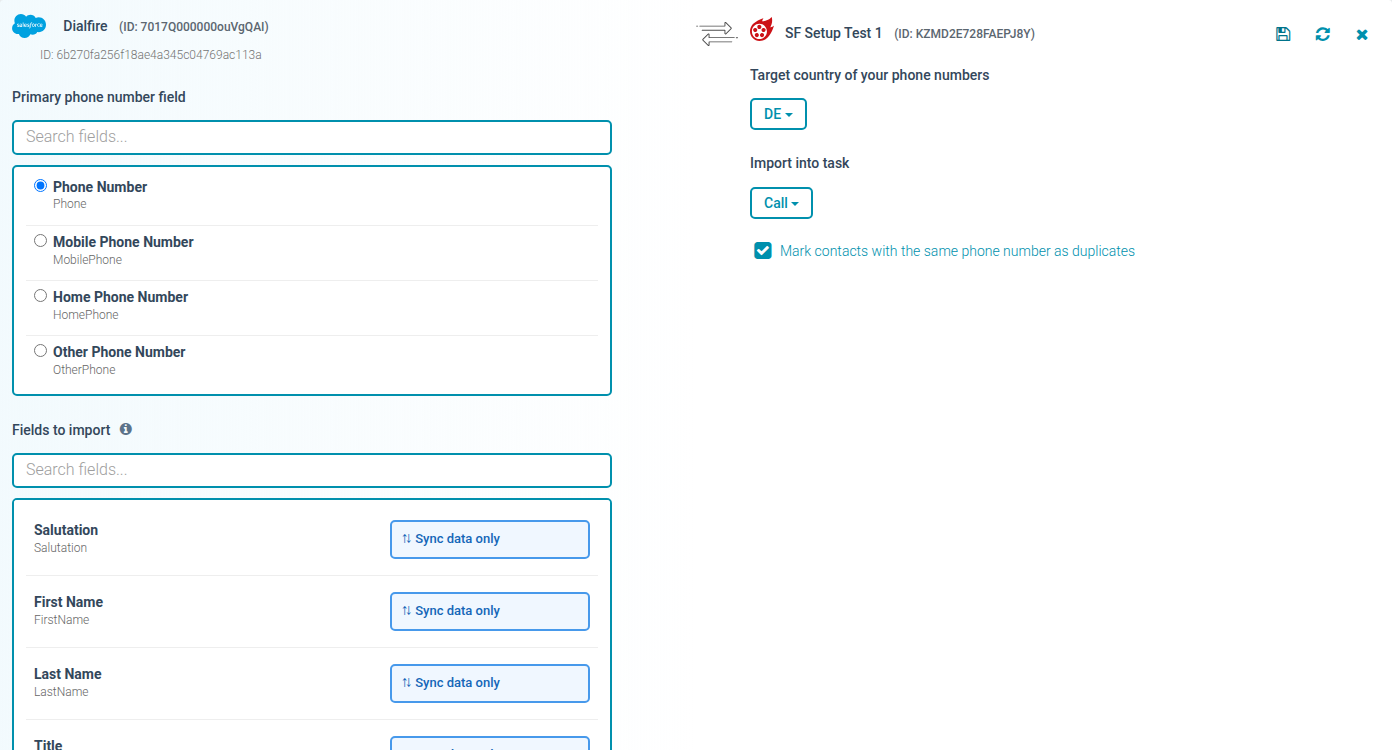
Open the binding with .
- Fields: separate lists for common fields, campaign member fields, contact fields and lead fields. Name, title, phone, mobile, e-mail, company, address and member status are preselected. Your own custom fields are available too.
- Primary phone number field: choose which number is dialed: Phone, Mobile, Home or Other. Make sure the chosen field is also switched on in the field list. Home and Other only exist on contacts.
How the synchronization works
- New members of the campaign arrive with the regular synchronization, and faster when the Dialfire package reports the change.
- Changes to existing records are applied at night (between 1 and 5 am) or when you click Synchronize.
- Members removed from the Salesforce campaign are taken out of the call queue once two synchronizations confirm it.
What Dialfire writes to Salesforce
After each call, when the contact passes the Salesforce Push task:
- Call task: a completed task "Call in Dialfire" of type call on the lead or contact, with the call result, direction, duration and a link to the recording.
- Campaign member status: if the agent changed it in Dialfire.
- Fields: changed values of the selected lead and contact fields. Converted leads are left alone.
- Event (calendar campaign): a booked appointment becomes a Salesforce event.
Setting up Dialfire for your calls
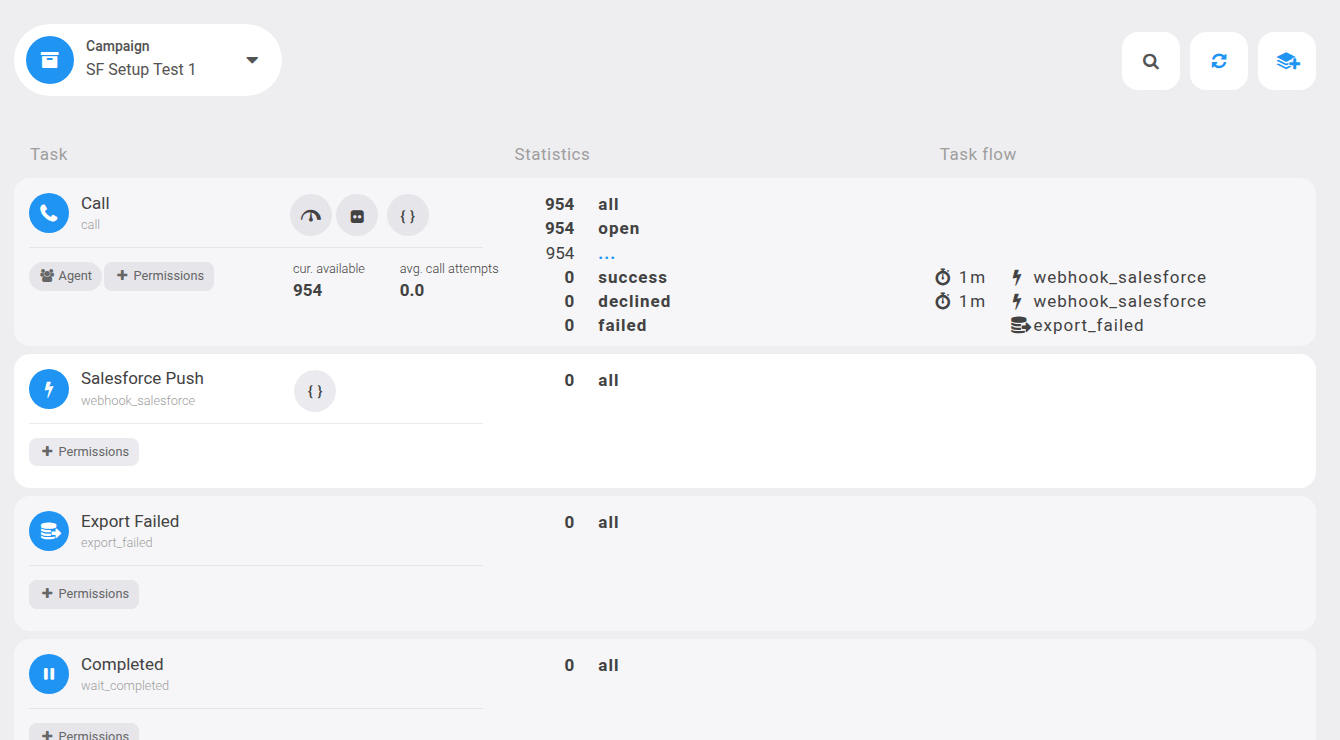
Each binding creates a new campaign in your Dialfire account. Log in to Dialfire and:
- Set the caller ID for your outgoing calls.
- Add your agents in the Users menu.
- Check the call and recording settings of the tasks.
- Check the contact form (menu Campaign, Form view) and make sure the fields your agents need are visible.
The campaign template already contains the Salesforce Push task, which sends the results to the CRM after each call. You can adapt the task flow and the form to your needs at any time.
Need help?
New to Dialfire? Have a look at our documentation or contact our support team.
Troubleshooting
| Situation | Solution |
|---|---|
| "No Salesforce campaigns found" | Create a campaign and set it to Active, then reload. |
| "If your Salesforce admin has blocked this app, please request access." | Ask your Salesforce administrator to allow the Dialfire app, then click Try authorization again. |
| "The Salesforce authorization is not getting anywhere" | Check that the Dialfire package is still installed, then click Go to the Salesforce authorization. |
| Home or other phone numbers are not dialed | Switch the field on in the field list as well, and remember that these fields only exist on contacts. |