Visual Real-Time Diagnostics in Technical Support
The Problem
Faults in heat pumps often cannot be validated over the phone. The conventional process forces an asynchronous media break: the call is escalated, and the customer must manually send photos via email to a ticketing system. This latency inevitably generates repeat calls, increases Average Handling Time (AHT), and leads to inefficient allocation of field service resources (truck rolls) for trivial service cases. The root cause lies in the system architecture: communication channels and visual data capture operate asynchronously and prevent immediate case resolution.
The Solution
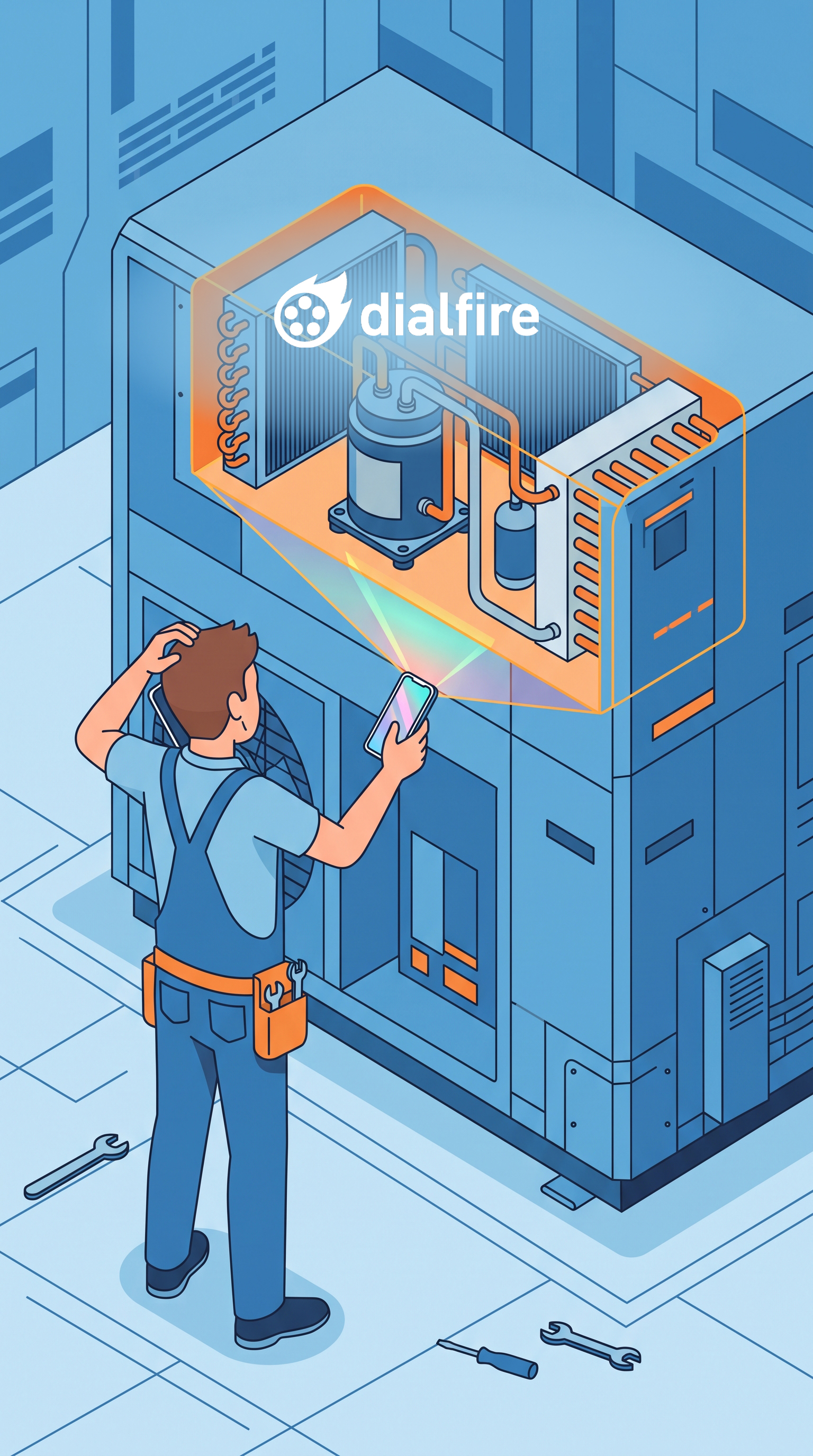
Visual data capture is deterministically integrated into the live conversation process. Via the individually configurable agent interface in Dialfire, a secure upload link is triggered with a single click. The customer takes a photo of the system using their smartphone, after which the image is displayed in real time directly within the contact record of the active interface – entirely without detouring through a traditional ticketing or case management system. Through the dynamic adaptation of the call guide, the support process remains synchronized, asynchronous media breaks are eliminated, and First Call Resolution (FCR) is significantly improved.
Interview: Technical Support at a Heating and Climate Technology Manufacturer
A conversation between a Chief Operating Officer, COO (J) and Dialfire (SA).
J (Energy Provider:)
“Our core problem was the first contact in technical support. With complex heat pumps, a verbal fault description over the phone is simply not enough. Agents had to terminate the call, open a ticket, and ask the customer, for example, to send photos of the heating system display via email. The underlying data logistics were completely asynchronous. By the time the images were available in the system and a follow-up contact took place, the customer had often been sitting in the cold for hours. In effect, we were working against our own IT systems – and against the goal of First Call Resolution.”
SA (Dialfire:)
“That is a classic architecture problem in omnichannel management. In many systems, telephony and visual data capture are optimized for asynchronous data storage rather than time-critical execution. We position Dialfire as an orchestrated hub in between. Instead of forcing the customer into an email process, the agent generates a link directly from the individually configurable interface with a single click. The system immediately sends an SMS with this upload link to the customer’s smartphone in the boiler room. The uploaded image is displayed in real time directly in the contact record of the active agent interface, without intermediate storage in email inboxes.”
J (Energy Provider:)
“Internally, this was quite controversial. Support technicians were skeptical about imposing yet another technical process on customers during a heating outage. The concern was additional complexity, app downloads, and frustrated customers, which would further increase AHT.”
SA (Dialfire:)
“We are familiar with that discussion. Technically speaking, we reduce complexity because app downloads and manual email attachments are eliminated. Customers use a browser-based photo module that runs natively on every smartphone. At the same time, the image upload is synchronized exactly with the active record on the system side. This makes the data flow максимально simple for the customer and transparent and delay-free for the agent instead of fragile.”
J (Energy Provider:)
“A real bottleneck in the past was ticket escalation. Without an image, we could not validate the exact system pressure on the pressure gauge or specific sensor error codes. We blocked expensive technicians for on-site appointments simply because we could not deterministically clarify the actual condition remotely – often the customer only needed to refill water. This was inefficient and drove up the cost per case.”
SA (Dialfire:)
“Diagnostic reliability belongs in the system. Through the dynamic call guide in the interface, we directly link live telephony with visual confirmation. The agent sees the system in real time. This eliminates the risk of misdiagnosis caused by inaccurate descriptions. The problem is visually verified and resolved during the initial conversation. Once resolved, the agent saves the contact with the appropriate status and status detail, after which the record is deterministically processed further through the task flow, for example returning to the system as a completed case via webhook.”
J (Energy Provider:)
“That had a measurable effect. Our second and third customer contacts dropped dramatically, and for the first time we are seeing customer satisfaction increase because the issue is resolved immediately. Previously, agents spent time on callbacks that were effectively avoidable.”
SA (Dialfire:)
“This is exactly where the efficiency gain is created: we allocate agent time only where an immediate resolution is possible. The configured logic also handles latency scenarios: if the customer needs more time in the basement to take the photo and the call is temporarily ended, the system safeguards the process. A successful upload updates the record, initiates an automated status change, and transfers the contact via call order or the native callback function directly to the next available agent. The process remains 100% SLA-compliant, and no record falls out of active monitoring.”
J (Energy Provider:)
“Scalability was also critical for us. What happens during the winter heating season with massive call peaks? What if the connection in the basement drops or the upload fails? Previously, such cases remained indefinitely stuck in the mail server and caused frustration.”
SA (Dialfire:)
“The routing is event-based and resilient to errors. The generated links are state-bound. Every uploaded image is uniquely assigned to the corresponding contact record and stored centrally there. Losses due to system breaks are impossible, regardless of how high the call volume becomes during peak season.”
J (Energy Provider):
“Meanwhile, we have scaled this framework beyond classic reactive troubleshooting. We now also use it for the deterministic acceptance of new installations or for validating warranty claims. As soon as the system detects incomplete data relating to a third-party component, we trigger the SMS logic for audit-proof photographic documentation of the type plate.”
SA (Dialfire:)
“That is exactly what the system was built for. Whenever documentation becomes necessary, it is a clear signal. This trigger goes directly into Dialfire and is immediately reflected in the contact record. There, the combination of status and status detail determines into which campaign stage the contact is moved next. Individually configured custom fields enable skill-based routing, directing the record specifically to the appropriate available agents or warranty teams – including the visual context. Operationally, this is an enormous acceleration.”
J (Energy Provider:)
“The biggest operational advantage for us was that we did not have to rebuild our core systems. The SAP ticketing system remains cumbersome but stable for maintaining system history. Dialfire functions as a flexible processing layer in near real time: the call is running, the upload link is sent, the display image is received directly in the contact record, and the agent saves the interface with the appropriate status and status detail. Based on this status logic, the task flow continues processing the record and closes the case in the core system. The architecture completely eliminates the media break.”
SA (Dialfire:)
“That is exactly the approach. We do not replace existing systems. We bypass their latency. Efficiency is created where visual data is translated directly into action without batch delays or email detours – traceable, measurable, and without manual intermediate steps.”