"Live" contact approach for web leads
The Problem
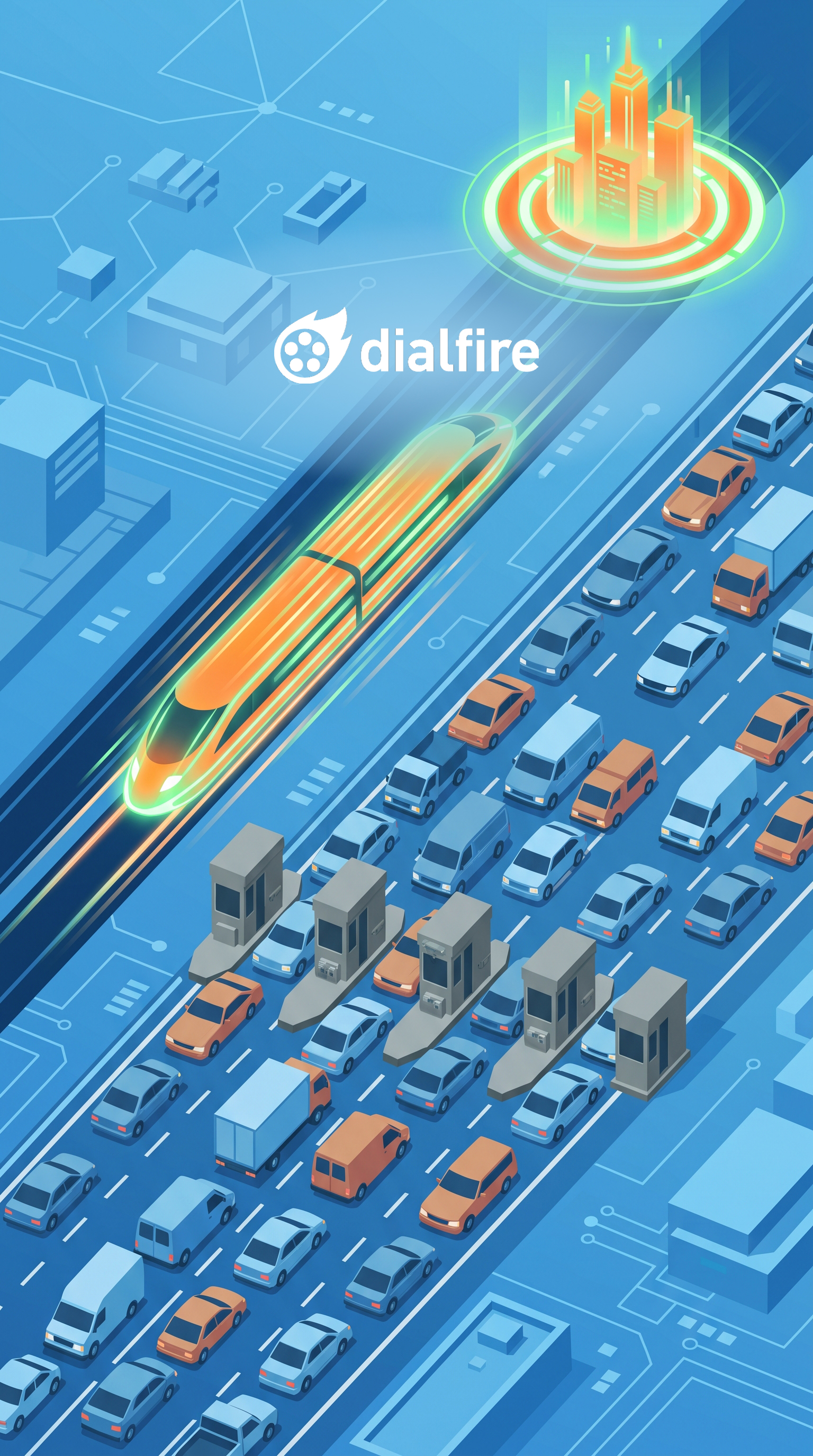
In conventional setups, web inquiries are processed asynchronously. They end up in email inboxes or CRM queues, are synchronized through batch processes, and manually or delayed transferred to call center teams. This system architecture effectively treats time-critical, “warm” leads like static lists. The First Response Time (FRT) increases to several hours. Agents access pools unsystematically, and prioritization is missing. The process window for optimal conversion closes, leads cool off, or move to competitors. The root cause lies in legacy systems that are designed for pure data consistency rather than event-driven real-time execution.
The Solution
The processing of contact requests is decoupled from data storage and handled in real time on an event-driven basis. The web frontend transfers the dataset directly to Dialfire via REST API. Instead of taking a detour through a separate task, the system immediately applies the native callback function or control via call order. The contact opens instantly in the processing interface of the next available agent without any manual intermediate steps. The latency between inquiry and call is reduced to under one minute. Prioritization and follow-up routing are rule-based, enabling maximum scalability of reachability and conversion rates.
Interview: Live Lead Conversion at a Financial Services Provider
A conversation between an Operations Manager (J) and Dialfire (SA).
J (Energy provider:)
“Our core problem was the First Response Time for online loan inquiries. The lead came in through the website, sat in the CRM, and at some point during the day an agent would pick it up. The data logistics were completely asynchronous. It often took 24 hours before a callback happened. By then, the customer had often already received approval from a competitor platform. We burned through massive amounts of qualified leads because the processing was too slow.”
SA (Dialfire:)
“That is a classic architecture problem. CRM systems manage states; they are not built for time-critical, event-driven execution. We use Dialfire here as an orchestrated execution layer. Instead of allowing leads to accumulate in CRM views, the web form directly triggers a webhook. The dataset is transferred to Dialfire via API and becomes available to the agent in real time – without detours through lists, tasks, or manual exports.”
J (Energy provider:)
“Internally, there were discussions. IT was skeptical about building a direct API bridge from the website into the call center instead of routing everything strictly through the CRM. The concern was losing control over the datasets.”
SA (Dialfire:)
“Technically speaking, we actually increase control because we eliminate latency and manual sources of error. Dialfire processes every web lead immediately. We do not use a separate task for this: the native callback function is applied directly for manageable lead volumes, while larger volumes are controlled through call order. Feedback to the CRM takes place synchronously after the conversation. The data flow remains transparent while being massively accelerated.”
J (Energy provider:)
“A real bottleneck for us used to be assignment. When 50 leads came in, agents didn’t know whom to call first. High loan amounts were displayed alongside general service inquiries in the same view. That cost valuable minutes.”
SA (Dialfire:)
“Routing and prioritization belong in the system logic, not in the hands of the agent. As soon as the lead enters through the API, we assign the priority – depending on lead volume – via the native callback or call order. Web leads immediately receive the highest priority. The contact interface opens instantly and without intermediate steps for the next available agent. The agent does not need to search; the most important lead is delivered within under a minute and the conversation is initiated immediately.”
J (Energy provider:)
“That had a dramatic effect on our KPIs. Our reachability rate jumped from 60% to over 85%, simply because we had customers on the phone while they still effectively had our website open on their screen. The conversion rate also more than doubled.”
SA (Dialfire:)
“That is exactly what live contact handling is about. Net working time is concentrated on highly convertible time windows. At the same time, we make process quality measurable. For example, if too much time passes before a call is made, defined escalation rules within the system logic take effect. Lost leads due to expired time windows are therefore minimized at the system level.”
J (Energy provider:)
“Scalability was also critical for us. Whenever we ran marketing campaigns, there were lead spikes. The old system collapsed under the load, and callbacks piled up for days.”
SA (Dialfire:)
“The API-supported routing in Dialfire is event-based and scales horizontally. Whether 10 or 10,000 leads are generated per hour, processing runs in real time through callback or call order. Every dataset is routed uniquely, and duplicate processing by different agents is excluded.”
J (Energy provider):
“The biggest operational advantage for us is that the CRM remained untouched as the leading system for data storage. Dialfire acts as an extremely fast upstream processing layer for direct customer interaction. Leads come in live, are converted, and the result flows cleanly back into the core system.”
SA (Dialfire:)
“That is exactly the approach. We do not replace existing systems; we bypass their architectural inertia. Efficiency and high conversion rates arise where a web event is translated into a direct customer dialogue without delay.”